My mom, who is 75, wants to go up to teeny tiny town near Rapid City,
to see her sister, who is 80. They live in a house in the boonies and
have no internet.
I'll be back online on Monday the 24th and promise not to miss another day.
Please bear with me, your patience is appreciated!

Wednesday, September 19, 2012

Monday, September 17, 2012
If Only This Goes On
From New York Times: Op ed piece: If Only This Goes On (From Sept 7)

A while back I mentioned, in a quite different context, an essay by Isaac Asimov (?) on Soviet science fiction,
in which he argued that the two main themes of Western sci-fi — “what
if” and “if only” — were ruled out; instead, writers wrote on the theme
“if only this goes on”.
And that was the theme of Obama’s speech last night. And you know what? That was perfectly fine.
Obama
couldn’t talk about how wonderful things are, because they aren’t. Nor
could he run against his own record. So he had to make the case that
things will get much better if he gets a second term, while getting much
worse if he doesn’t.
And there’s a
lot to that case. If Obama is reelected, we’ll have near-universal
health coverage by 2014. That’s a very big thing. Financial reform is
also important — and has already been enacted. And there’s a good chance
that he’ll get to preside over an economic recovery that will validate his record, too.
There’s
been a chorus of disapproval from pundits who wanted … what? It wasn’t
appropriate for him to replay the Clinton wonkfest. He wasn’t going to
unveil major new proposals. He made the case he needed to make, and did
it well.
On a related note, Digby catches National Review portraying Romney and Ryan as Stakhanovites:
Now, back to the hospital.
Thursday, September 6, 2012
question of the day: Why have the works of Isaac Asimov had such a singularly bad record of getting turned into movies?
From Flicvk Philosopher: question of the day: Why have the works of Isaac Asimov had such a singularly bad record of getting turned into movies?
The only major Hollywood film based on Asimov’s writings is Bicentennial Man, which flopped at the box office and was poorly received by critics. There’s also I, Robot, which did better at the box office and with critics, but is only extremely loosely based on Asimov’s fiction. All of Asimov’s other film and TV credits are for shorts or TV episodes, despite his massive bibliography and general acclaim as one of the grandmasters of science fiction. I’d venture to guess that Asimov’s name is synonymous with science fiction even among the general public who don’t read. It seems like a no-brainer for Hollywood to glom on to Asimov’s reputation to pre-sell films. So why hasn’t it?
Why have the works of Isaac Asimov had such a singularly bad record of getting turned into movies?
My guess: Asimov’s writing isn’t suited to visual storytelling, since it tends to be full of people talking to one another about interesting ideas but not always doing anything with them. Asimov’s fiction may be philosophically provocative, but it’s not generally dramatically interesting.
What do you think?
The only major Hollywood film based on Asimov’s writings is Bicentennial Man, which flopped at the box office and was poorly received by critics. There’s also I, Robot, which did better at the box office and with critics, but is only extremely loosely based on Asimov’s fiction. All of Asimov’s other film and TV credits are for shorts or TV episodes, despite his massive bibliography and general acclaim as one of the grandmasters of science fiction. I’d venture to guess that Asimov’s name is synonymous with science fiction even among the general public who don’t read. It seems like a no-brainer for Hollywood to glom on to Asimov’s reputation to pre-sell films. So why hasn’t it?
Why have the works of Isaac Asimov had such a singularly bad record of getting turned into movies?
My guess: Asimov’s writing isn’t suited to visual storytelling, since it tends to be full of people talking to one another about interesting ideas but not always doing anything with them. Asimov’s fiction may be philosophically provocative, but it’s not generally dramatically interesting.
What do you think?
Wednesday, September 5, 2012
HE wrote mysteries?! Isaac Asimov
From KB Owen, Mystery Writer blog: HE wrote mysteries?! Isaac Asimov
We think of Isaac Asimov (1920-1992) first and foremost as the father of modern science fiction. He’s especially well-known for his Foundation Trilogy, and his Robot series. Even outside the world of science fiction fandom, I, Robot is recognized as a blockbuster film, and many of the ideas we have about robots came from him.
Asimov fans may also know that he used to be a biochemistry professor, was friends with writers such as Harlan Ellison, gave advice to his good friend Gene Roddenberry on the making of Star Trek: the Motion Picture (and appears in the screen credits), and had an asteroid named after him.
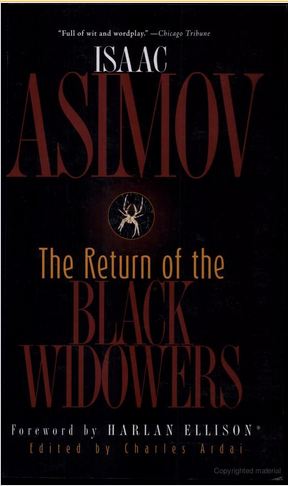
But we’re going to focus here on his mystery writing. Most of his mysteries took the form of a short story series, known as The Black Widowers Club. The Black Widowers Club is a male-only group that meets monthly over dinner in a private dining room. Asimov’s first short story, “The Acquisitive Chuckle,” describes the group:
The first Black Widowers story was published in 1971 in Ellery Queen Mystery Magazine, with 65 more to follow – some published in EQMM or other magazines over the years, others collected into volumes (although all were eventually collected into anthologies).
Asimov was a big fan of the ratiocinative (thinking) armchair detective, rather than the fists-first, hard-drinking P.I. He enjoyed Agatha Christie’s detective, Hercule Poirot, and was a member of the Baker Street Irregulars, a club comprised of Sherlockian aficionados. So it’s no surprise that his Black Widowers stories are in the style of cozy armchair puzzles.
There’s a definite formula to each of the stories:
We think of Isaac Asimov (1920-1992) first and foremost as the father of modern science fiction. He’s especially well-known for his Foundation Trilogy, and his Robot series. Even outside the world of science fiction fandom, I, Robot is recognized as a blockbuster film, and many of the ideas we have about robots came from him.
Asimov fans may also know that he used to be a biochemistry professor, was friends with writers such as Harlan Ellison, gave advice to his good friend Gene Roddenberry on the making of Star Trek: the Motion Picture (and appears in the screen credits), and had an asteroid named after him.
But we’re going to focus here on his mystery writing. Most of his mysteries took the form of a short story series, known as The Black Widowers Club. The Black Widowers Club is a male-only group that meets monthly over dinner in a private dining room. Asimov’s first short story, “The Acquisitive Chuckle,” describes the group:
…the Black Widowers, who monthly met in their quiet haunt and vowed death to any female who intruded – for that one night per month, at any rate.Each month, one member brings a guest for the evening, who is treated to a fine meal for the price of presenting a real-life puzzle (that he knows the answer to) which the members must solve. The group is modeled after a society that Asimov himself belonged to, The Trap-Door Spiders (basically guys getting away from their haranguing wives on a Friday night; very little mystery-solving was involved with the real group).
The first Black Widowers story was published in 1971 in Ellery Queen Mystery Magazine, with 65 more to follow – some published in EQMM or other magazines over the years, others collected into volumes (although all were eventually collected into anthologies).
Asimov was a big fan of the ratiocinative (thinking) armchair detective, rather than the fists-first, hard-drinking P.I. He enjoyed Agatha Christie’s detective, Hercule Poirot, and was a member of the Baker Street Irregulars, a club comprised of Sherlockian aficionados. So it’s no surprise that his Black Widowers stories are in the style of cozy armchair puzzles.
There’s a definite formula to each of the stories:
- Opens with banter/light discussion between the regular members (of which there are 7 – plus the waiter, Henry), with a quick set-up of their various professions/quirks
- Introduction of guest
- drinks are served; dinner is served
- Guest is asked the following question: “How do you justify your existence?”
- Guest answers in some fashion, as a segueway to the puzzle to be presented.
- Puzzle is presented
- Henry is clearing the plates and listening
- Back-and-forth between members and guest to clarify points.
- Members make guesses, but are wrong/stumped.
- Members turn to Henry, who (very modestly) solves the puzzle, but doesn’t accept praise, claiming that the members had a hand in it by eliminating all of the other possibilities.
Thursday, August 30, 2012
Posts resume Saturday
Posts resume Saturday! I'm getting ready for Labor Day weekend tomorrow (Friday.)
Sunday, August 26, 2012
Welcome to P.S. 99 The Isaac Asimov School for Science and Literature
I didn't know Isaac had a school named after him!
Welcome to P.S. 99 The Isaac Asimov School for Science and Literature
http://schools.nyc.gov/SchoolPortals/21/K099/default.htm

Come and Visit the New Home of PS/IS 99 The Isaac Asimov School For Science and Literature: www.PS99Brooklyn.org
Unfortunately - PS99Brooklyn.org is no longer active...I hope this doesn't mean the school hasn't closed!
Welcome to P.S. 99 The Isaac Asimov School for Science and Literature
http://schools.nyc.gov/SchoolPortals/21/K099/default.htm
Come and Visit the New Home of PS/IS 99 The Isaac Asimov School For Science and Literature: www.PS99Brooklyn.org
Unfortunately - PS99Brooklyn.org is no longer active...I hope this doesn't mean the school hasn't closed!
Thursday, August 23, 2012
Catching Up With Tom Swift a Century Later
From NPR:
Catching Up With Tom Swift a Century Later
Science fiction hero Tom Swift has amazed children with his incredible inventions since combustion and electricity drove the nation into a new era. These stories captured a cultural love of science and inspired such famous figures as Steve Wozniak and Isaac Asimov — all while predicting new technologies decades in advance.
RA FLATOW, HOST:
Have you heard about the electric locomotive that can make two miles a minute? That's pretty fast. Maybe you call it the bullet train. Or how about a rifle that can shoot electric bullets and disable its victim? You might call it a Taser today. In fact, both of these inventions were first described by that famous fictional teenage inventor, Tom Swift, way back at the dawn of the 20th century.
New inventions back then brought electricity to light our cities, combustion engines to drive our cars. Science made it all happen, and in this new age, you know, they needed a new role model to reflect the times. An engineer? A scientist? No. How about an inventor?
Tom Swift, boy inventor, has inspired children with his incredible creations for over a century. Some of those children include Steve Wozniak, Isaac Asimov, Jack Cover, inventor of the Taser, who named his device as an acronym of Thomas A. Swift's Electric Rifle, one of Tom's many fictional inventions.
Are you a Tom Swift fan? Marc Abrahams is, and he's here to talk about the book series and some of Tom's inventions that have predicted technology decades in advance. He's editor and co-founder of the Annals of Improbable Research and founder and master of ceremonies for the Ig Nobel Prize Ceremony. Welcome to - welcome back, Marc.
MARC ABRAHAMS: Thanks, Ira.
FLATOW: Wow, what a list of stuff he came up with.
ABRAHAMS: It was an amazing list. This started around 1910. There was a long list of books, and, at the start, they were things that sound pretty ordinary now, the things you mentioned, titles of things like "Tom Swift and His Airship," "Tom Swift and His Wireless Message." My favorite is "Tom Swift and His Photo Telephone." If you read "Tom Swift and His Photo Telephone," which is written in 1914, it sounds like you're hearing the description of Skype or Google Hangout.
(LAUGHTER)
ABRAHAMS: The boy inventor invented this in 1914 fictionally, but the details are surprisingly similar.
FLATOW: Are people still reading those books, the Tom Swift books?
ABRAHAMS: That's a good question. There were two big series. The first series started in 1910, went up to about 1940. They updated it in the 1950s and '60s with things like "Tom Swift and His Rocket Ship," "Tom Swift and His Giant Robot" and on and on. Those petered out. And they started up a few later, but the later ones just got off into sort of fantasy.
The initial ones really had a lot to do with science and invention, and they were a way to sell books, but also a way to get kids really interested in this stuff. And a lot of scientists grew up...
FLATOW: Yeah.
ABRAHAMS: ...slurping this stuff down.
FLATOW: Was there one author for all of this?
ABRAHAMS: It depends on how you want to look at it. They were all listed as being written by Victor Appleton.
FLATOW: Right.
ABRAHAMS: In fact, there was a guy named Edward Stratemeyer who apparently was amazingly clever. He started what's called the Stratemeyer Syndicate. He would write out little, short versions of this and hire authors who would write these books, all using the same pen name. This is the same guy, the same factory that put out a long series of books - the "Nancy Drew Mystery Stories," also the "Hardy Boys Adventures."
FLATOW: Oh, no kidding.
ABRAHAMS: There were a bunch of others, "The Rover Boys," a whole bunch, all out of this little, tiny factory.
FLATOW: Wow. Anything like it around today?
ABRAHAMS: There are a million things descended from it. As far as I know, there's nothing really like it that would center each one on...
FLATOW: Yeah.
ABRAHAMS: ...an invention or a piece of science. And I wish somebody would do it anew and wonderfully.
FLATOW: I remember Danny Dunn, he came later...
ABRAHAMS: Yeah. That was - I'm pretty sure Danny Dunn came out of a different person, but I couldn't guarantee that.
FLATOW: Yeah. I think "His Electric Something Paint" and...
ABRAHAMS: I have a feeling you read a lot of this.
FLATOW: I did. "Anti-Gravity Paint," or something like that. It's all fascinating.
ABRAHAMS: Yeah, yeah.
FLATOW: It's all good stuff. Thank you, Marc.
ABRAHAMS: Thank you, Ira.
FLATOW: See you next time. Marc Abrahams is editor and co-founder of the Annals of Improbable Research, also founder and master of ceremonies at the Ig Nobel Prize Ceremony, which you can hear on SCIENCE FRIDAY every Friday following Thanksgiving.
Science fiction hero Tom Swift has amazed children with his incredible inventions since combustion and electricity drove the nation into a new era. These stories captured a cultural love of science and inspired such famous figures as Steve Wozniak and Isaac Asimov — all while predicting new technologies decades in advance.
RA FLATOW, HOST:
Have you heard about the electric locomotive that can make two miles a minute? That's pretty fast. Maybe you call it the bullet train. Or how about a rifle that can shoot electric bullets and disable its victim? You might call it a Taser today. In fact, both of these inventions were first described by that famous fictional teenage inventor, Tom Swift, way back at the dawn of the 20th century.
New inventions back then brought electricity to light our cities, combustion engines to drive our cars. Science made it all happen, and in this new age, you know, they needed a new role model to reflect the times. An engineer? A scientist? No. How about an inventor?
Tom Swift, boy inventor, has inspired children with his incredible creations for over a century. Some of those children include Steve Wozniak, Isaac Asimov, Jack Cover, inventor of the Taser, who named his device as an acronym of Thomas A. Swift's Electric Rifle, one of Tom's many fictional inventions.
Are you a Tom Swift fan? Marc Abrahams is, and he's here to talk about the book series and some of Tom's inventions that have predicted technology decades in advance. He's editor and co-founder of the Annals of Improbable Research and founder and master of ceremonies for the Ig Nobel Prize Ceremony. Welcome to - welcome back, Marc.
MARC ABRAHAMS: Thanks, Ira.
FLATOW: Wow, what a list of stuff he came up with.
ABRAHAMS: It was an amazing list. This started around 1910. There was a long list of books, and, at the start, they were things that sound pretty ordinary now, the things you mentioned, titles of things like "Tom Swift and His Airship," "Tom Swift and His Wireless Message." My favorite is "Tom Swift and His Photo Telephone." If you read "Tom Swift and His Photo Telephone," which is written in 1914, it sounds like you're hearing the description of Skype or Google Hangout.
(LAUGHTER)
ABRAHAMS: The boy inventor invented this in 1914 fictionally, but the details are surprisingly similar.
FLATOW: Are people still reading those books, the Tom Swift books?
ABRAHAMS: That's a good question. There were two big series. The first series started in 1910, went up to about 1940. They updated it in the 1950s and '60s with things like "Tom Swift and His Rocket Ship," "Tom Swift and His Giant Robot" and on and on. Those petered out. And they started up a few later, but the later ones just got off into sort of fantasy.
The initial ones really had a lot to do with science and invention, and they were a way to sell books, but also a way to get kids really interested in this stuff. And a lot of scientists grew up...
FLATOW: Yeah.
ABRAHAMS: ...slurping this stuff down.
FLATOW: Was there one author for all of this?
ABRAHAMS: It depends on how you want to look at it. They were all listed as being written by Victor Appleton.
FLATOW: Right.
ABRAHAMS: In fact, there was a guy named Edward Stratemeyer who apparently was amazingly clever. He started what's called the Stratemeyer Syndicate. He would write out little, short versions of this and hire authors who would write these books, all using the same pen name. This is the same guy, the same factory that put out a long series of books - the "Nancy Drew Mystery Stories," also the "Hardy Boys Adventures."
FLATOW: Oh, no kidding.
ABRAHAMS: There were a bunch of others, "The Rover Boys," a whole bunch, all out of this little, tiny factory.
FLATOW: Wow. Anything like it around today?
ABRAHAMS: There are a million things descended from it. As far as I know, there's nothing really like it that would center each one on...
FLATOW: Yeah.
ABRAHAMS: ...an invention or a piece of science. And I wish somebody would do it anew and wonderfully.
FLATOW: I remember Danny Dunn, he came later...
ABRAHAMS: Yeah. That was - I'm pretty sure Danny Dunn came out of a different person, but I couldn't guarantee that.
FLATOW: Yeah. I think "His Electric Something Paint" and...
ABRAHAMS: I have a feeling you read a lot of this.
FLATOW: I did. "Anti-Gravity Paint," or something like that. It's all fascinating.
ABRAHAMS: Yeah, yeah.
FLATOW: It's all good stuff. Thank you, Marc.
ABRAHAMS: Thank you, Ira.
FLATOW: See you next time. Marc Abrahams is editor and co-founder of the Annals of Improbable Research, also founder and master of ceremonies at the Ig Nobel Prize Ceremony, which you can hear on SCIENCE FRIDAY every Friday following Thanksgiving.
Subscribe to:
Posts (Atom)